
A Song for Someone You Miss: Coffee and Saudade
Turn an everyday coffee ritual into a personal song for someone you miss, with a Brazilian Portuguese story about a grandmother's lasting care.
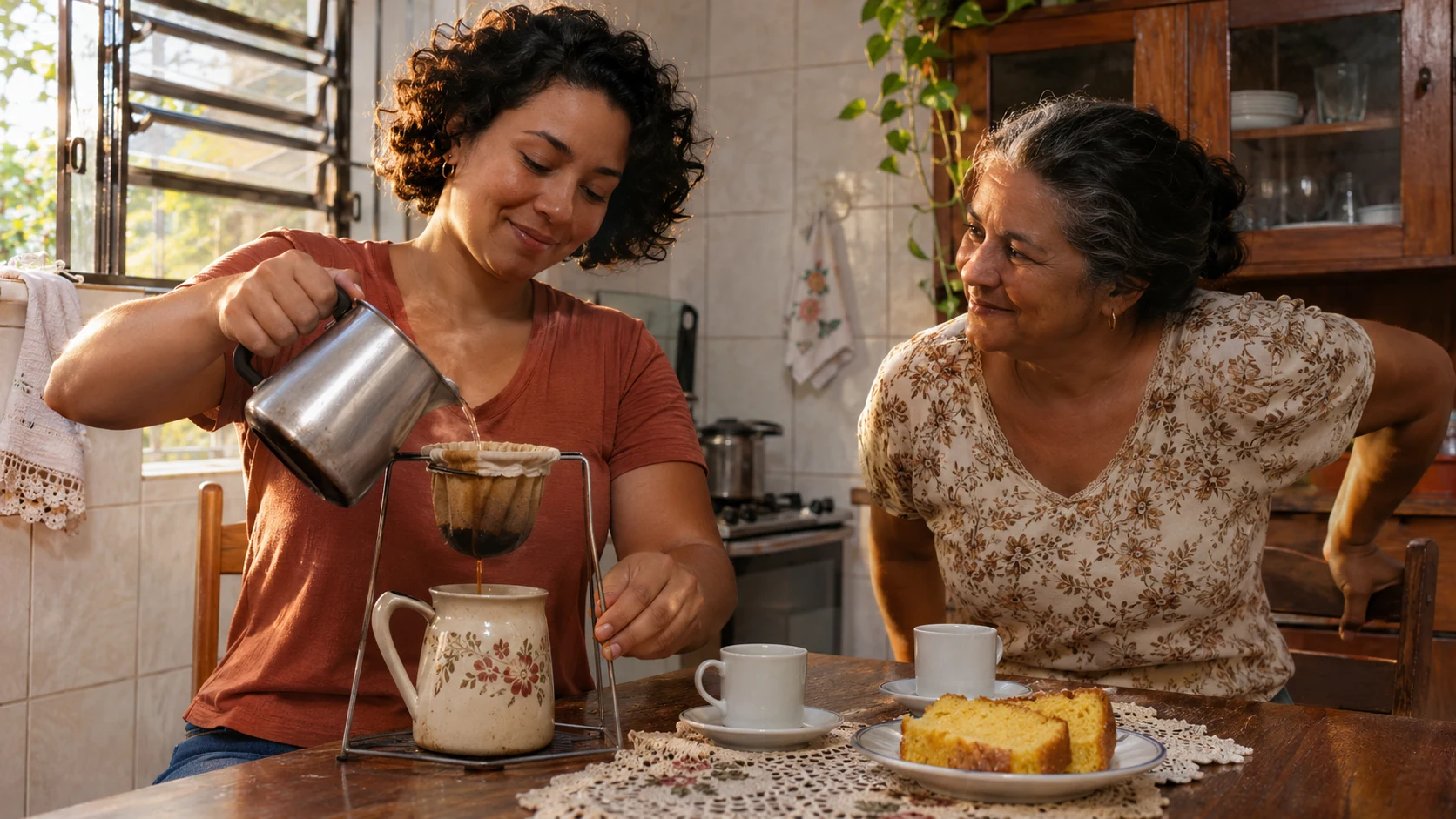
Sometimes you remember a person through something your hands do before you have thought about it. You take two cups from a shelf. You leave a little room for milk. You know where the good spoon belongs, even in a kitchen you no longer visit every week.
A song for someone you miss can begin there. You can describe the routine and let the feeling arrive in its own time.
Two cups on an ordinary afternoon
“Ainda Faço Seu Café,” meaning “I Still Make Your Coffee,” is our Brazilian Portuguese song story about Bia, a fictional granddaughter. She returns to the home where her late grandmother used to make afternoon coffee. There is cornmeal cake cooling beside the stove, and a cloth filter waiting above the coffee pot.
Bia reaches for two cups out of habit. Then her aunt arrives, saying she has only stopped by for a moment. She sees the cake and pulls up a chair. They share a familiar story, laugh before its ending, and eventually start talking about the market and the weather.
The second cup goes to someone who is still there. Bia does not mistake that person for her grandmother. She finds a way to continue the care she learned from her.
Bia and her family are fictional. This original story draws on published accounts of food and family memory, with newly written characters, scenes and lyrics. It is not a customer testimonial, and no real person is presented as having used Sung with Love. The accompanying illustration is AI-generated.
Choose a habit that really belonged to them
For your own memorial song, begin with what you actually remember. Perhaps your grandfather always cut fruit for everyone. Your mother kept a pen beside the crossword. A friend called during a particular part of your journey home.
Ask yourself what made that action theirs. Was it the order they did things in, the comment they repeated, or the way they waited for you? Those details give a lyric something to show. You can keep the person recognizable without explaining every part of their life.
Food is one possible way in. Brazilian cultural programming from Sesc São Paulo has used the smell of filtered coffee at a grandmother's home as an example of sensory memory. The detail belongs in a song when it fits the particular family, rather than because a country is expected to look a certain way.
Leave room for the feeling to stay unfinished
The chorus in Bia's story allows her to sit for a while without finding an answer to missing her grandmother. It does not promise that a melody will resolve grief. It also leaves room for an ordinary conversation and a small laugh.
When you review your own lyrics, look for conclusions that feel too neat. You may want to say thank you, remember a habit, or simply name the absence. Any of those can carry a song. You do not owe the listener a final lesson.
Keep the language you shared
Brazilian Portuguese words such as “saudade,” “xícara” and “coador” belong naturally in this particular story. A different family might use different words, objects or a different language altogether.
Use the form of address that feels familiar. Explain the pronunciation of names, and keep an expression your relative used if you want it included. Read the draft aloud. A line that looks elegant on a page can still feel unlike something you would say to them.
Finados, observed on November 2 in Brazil, can be a moment to remember, as confirmed in this year's Brazilian government holiday notice. Bia's coffee is a personal routine, not a prescribed Finados ceremony. The song can also belong to an ordinary afternoon later in the year.
Start with one memory you want to keep
Write a few sentences about the person, the routine and why it matters now. You can begin your own song with Sung with Love, review and edit the lyrics for free, and use a generation allowance for a 60-second audio preview. Full-song access, the chosen MP3 and a gift page require a separate paid unlock. You can decide later whether to share the finished song or keep the moment to yourself.
The food-memory research behind this story includes Viviane Aguiar's account of a real letter between a grandson and grandmother. Its personal wording and family history are not reproduced here.